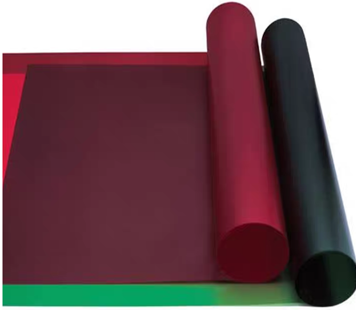
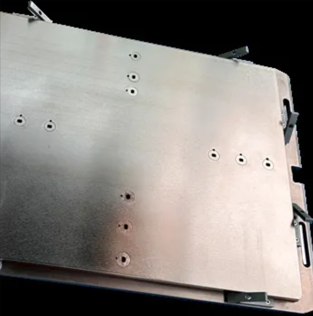
Aluminum Core Copper Clad Laminate
Aluminum core Copper Clad Laminate, also known as Aluminum base CCL, is a high-performance electronic substrate material made of an aluminum plate, a dielectric bonding layer, and a copper foil through a high-temperature hot pressing process. The metal layer in Aluminum core CCL provides excellent thermal conductivity, while the overall conductivity of the material is determined by the dielectric bonding layer. To further enhance its thermal conductivity, Aluminum core CCL can be filled with ceramic materials as the dielectric layer.
Most Aluminum PCB boards are built with a single-sided Copper Clad Laminate, while double-sided CCL are used for the manufacturing of double-sided Aluminum PCBs and multilayer hybrid Aluminum PCBs, which are a specialty at JHYPCB. With its excellent thermal conductivity and other advantageous properties, Aluminum core CCL has become an indispensable raw material in the production of high-performance electronic devices and is widely used in various industries.
Thermal conductivity available in a range of values: 1.0W/m·K, 1.5W/m·K, 2.0W/m·K, 3.0W/m·K, 4.2W/m·K, 5.0W/m·K, and 7.0W/m·K
Aluminum alloy style available in 1060 (138 W/m·K) and 5052 (220 W/m·K)
Copper style available in C1100 (386 W/m·K) with copper thickness in the range of 0.5oz to 2oz
Glass Transition Temperature (Tg) available in Tg100oC, Tg120oC, and Tg130oC
Dielectric Constant (Dk or Er) measures at 4.8 (@1MHz) and is halogen-free
Compatible with standard and lead-free assembly
High UL Rated Flammability: 94V-0
Aluminum Core CCL thickness available from 0.8mm to 2.0mm
Copper Core Copper Clad Laminate
Copper Core CCL, likewise Aluminum Core CCL, is a composite material consisting of a copper plate, dielectric bonding layer, and copper foil. The thermal conductivity of Copper Core CCL is primarily determined by the dielectric bonding layer as well as the thermal dissipation design of the board.
Copper Core PCB, also known as copper substrate PCB, copper-based PCB, or copper-clad PCB, comes in three main design types:
Standard Copper Core PCB: circuitry is placed on the copper layer without plated-through holes (PTHs)
Chip on Board (COB) Copper PCB: where the IC chip is directly mounted onto the copper layer of the board, providing a small form factor
Direct Thermal Path Copper-based PCB: this type of PCB does not have an insulator layer under the thermal path pad, allowing for optimal thermal dissipation.
It is important to note that Copper Core PCBs have a higher thermal conductivity than FR-4 PCBs, which makes them a popular choice for high-power applications where heat dissipation is critical. Copper Core PCBs are also used in electronic devices that require reliable operation in harsh environments, such as aerospace, automotive, and military applications.